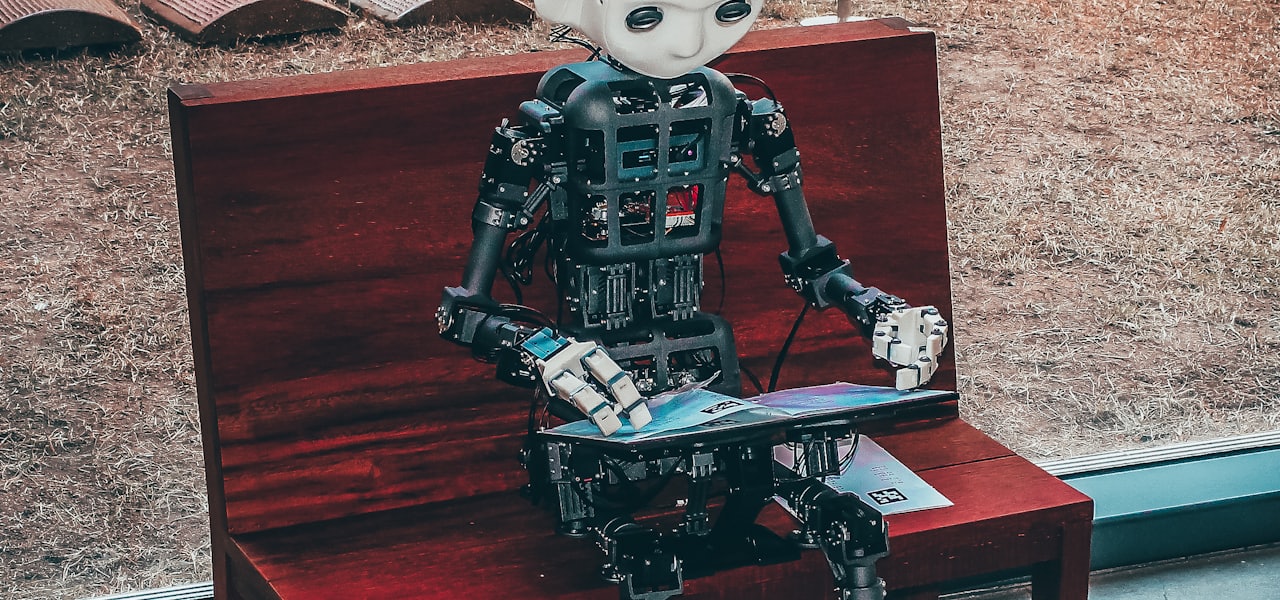
An artificial brain (or artificial mind) is software and hardware with cognitive abilities similar to those of the animal or human brain. Research investigating "artificial brains" and brain emulation plays three important roles in science: An ongoing attempt by neuroscientists to understand how the human brain works, known as cognitive neuroscience. A thought experiment in the philosophy of artificial intelligence, demonstrating that it is possible, at least in theory, to create a machine that has all the capabilities of a human being. A long-term project to create machines exhibiting behavior comparable to those of animals with complex central nervous system such as mammals and most particularly humans. The ultimate goal of creating a machine exhibiting human-like behavior or intelligence is sometimes called strong AI. An example of the first objective is the project reported by Aston University in Birmingham, England where researchers are using biological cells to create "neurospheres" (small clusters of neurons) in order to develop new treatments for diseases including Alzheimer's, motor neurone and Parkinson's disease. The second objective is a reply to arguments such as John Searle's Chinese room argument, Hubert Dreyfus's critique of AI or Roger Penrose's argument in The Emperor's New Mind. These critics argued that there are aspects of human consciousness or expertise that can not be simulated by machines. One reply to their arguments is that the biological processes inside the brain can be simulated to any degree of accuracy. This reply was made as early as 1950, by Alan Turing in his classic paper "Computing Machinery and Intelligence". The third objective is generally called artificial general intelligence by researchers. However, Ray Kurzweil prefers the term "strong AI". In his book The Singularity is Near, he focuses on whole brain emulation using conventional computing machines as an approach to implementing artificial brains, and claims (on grounds of computer power continuing an exponential growth trend) that this could be done by 2025. Henry Markram, director of the Blue Brain project (which is attempting brain emulation), made a similar claim (2020) at the Oxford TED conference in 2009. == Approaches to brain simulation == W. Ross Ashby's pioneering work in cybernetics provided an early mathematical framework for understanding adaptive brain-like systems. In his 1952 book Design for a Brain, Ashby proposed that the brain could be modeled as an ultrastable system that maintains equilibrium through continuous adaptation to environmental perturbations. His approach used differential equations and state-space models to describe how neural systems could exhibit purposeful behavior through feedback mechanisms. Ashby's homeostat, a physical machine built in 1948, demonstrated these principles through an electromechanical device with four interconnected units that automatically adjusted their parameters to maintain stability when disturbed. The homeostat represented one of the first attempts to build an artificial system exhibiting brain-like adaptive behavior, influencing subsequent work in adaptive systems, neural networks, and artificial intelligence. Although direct human brain emulation using artificial neural networks on a high-performance computing engine is a commonly discussed approach, there are other approaches. An alternative artificial brain implementation could be based on Holographic Neural Technology (HNeT) non linear phase coherence/decoherence principles. The analogy has been made to quantum processes through the core synaptic algorithm which has strong similarities to the quantum mechanical wave equation. EvBrain is a form of evolutionary software that can evolve "brainlike" neural networks, such as the network immediately behind the retina. In November 2008, IBM received a US$4.9 million grant from the Pentagon for research into creating intelligent computers. The Blue Brain project is being conducted with the assistance of IBM in Lausanne. The project is based on the premise that it is possible to artificially link the neurons "in the computer" by placing thirty million synapses in their proper three-dimensional position. Some proponents of strong AI speculated in 2009 that computers in connection with Blue Brain and Soul Catcher may exceed human intellectual capacity by around 2015, and that it is likely that we will be able to download the human brain at some time around 2050. While Blue Brain is able to represent complex neural connections on the large scale, the project does not achieve the link between brain activity and behaviors executed by the brain. In 2012, project Spaun (Semantic Pointer Architecture Unified Network) attempted to model multiple parts of the human brain through large-scale representations of neural connections that generate complex behaviors in addition to mapping. Spaun's design recreates elements of human brain anatomy. The model, consisting of approximately 2.5 million neurons, includes features of the visual and motor cortices, GABAergic and dopaminergic connections, the ventral tegmental area (VTA), substantia nigra, and others. The design allows for several functions in response to eight tasks, using visual inputs of typed or handwritten characters and outputs carried out by a mechanical arm. Spaun's functions include copying a drawing, recognizing images, and counting. There are good reasons to believe that, regardless of implementation strategy, the predictions of realising artificial brains in the near future are optimistic. In particular brains (including the human brain) and cognition are not currently well understood, and the scale of computation required is unknown. Another near term limitation is that all current approaches for brain simulation require orders of magnitude larger power consumption compared with a human brain. The human brain consumes about 20 W of power, whereas current supercomputers may use as much as 1 MW—i.e., an order of 100,000 more. == Artificial brain thought experiment == Some critics of brain simulation believe that it is simpler to create general intelligent action directly without imitating nature. Some commentators have used the analogy that early attempts to construct flying machines modeled them after birds, but that modern aircraft do not look like birds.
Key–value database
A key-value database, or key-value store, is a data storage paradigm designed for storing, retrieving, and managing associative arrays, a data structure more commonly known today as a dictionary. Dictionaries contain a collection of objects, or records, which in turn have many different fields within them. These records are stored and retrieved using a key that uniquely identifies the record, and is used to find the data within the database. Key-value databases differ from the better known relational databases (RDB). RDBs pre-define the data structure in the database as a series of tables containing fields with well-defined data types. Exposing the data types to the database program allows it to apply various optimizations. In contrast, key-value systems treat the value as opaque to the database itself, and typically support only simple operations such as storing, retrieving, updating, and deleting a value by its key. This offers considerable flexibility and makes such systems well suited to low-latency, high-throughput workloads dominated by direct key lookups, but less suitable for applications that require complex queries or explicit relationships among records. A lack of standardization, limited transaction support, and relatively simple query interfaces long restricted many key-value systems to specialized uses, but the rapid move to cloud computing after 2010 helped drive renewed interest in them as part of the broader NoSQL movement. Some graph databases, such as ArangoDB, are also key–value databases internally, adding the concept of relationships (pointers) between records as a first-class data type. == Types and examples == Key–value systems span a wide consistency spectrum, from eventually consistent designs to strongly consistent or serializable ones, and some allow the consistency level to be configured as part of the trade-off against latency and availability. Renewed interest in key–value and other NoSQL systems was driven in part by the demands of big data, distributed, and cloud applications. Their scalability and availability made them attractive for cloud data management, although limited transaction support, low-level query interfaces, and the lack of standardization remained obstacles to wider adoption. Some maintain data in memory (RAM), while others employ solid-state drives or rotating disks. Some key–value systems add additional structure to their keys. For example, Oracle NoSQL Database organizes records using composite keys with "major" and "minor" components, an arrangement that Oracle compares to a directory-path structure in a file system. More generally, however, key–value stores are defined by their use of unique keys associated with opaque values and by their emphasis on simple key-based operations. Unix included dbm (database manager), a minimal database library written by Ken Thompson for managing associative arrays with a single key and hash-based access. Later implementations and related libraries included sdbm, GNU dbm (gdbm), and Berkeley DB. A more recent example is RocksDB, a persistent key–value storage engine developed at Facebook and designed for large-scale applications. Other examples include in-memory systems such as Memcached and Redis, and persistent systems such as Berkeley DB, Riak, and Voldemort.
Photonically Optimized Embedded Microprocessors
The Photonically Optimized Embedded Microprocessors (POEM) is DARPA program. It should demonstrate photonic technologies that can be integrated within embedded microprocessors and enable energy-efficient high-capacity communications between the microprocessor and DRAM. For realizing POEM technology CMOS and DRAM-compatible photonic links should operate at high bit-rates with very low power dissipation. == Current research == Currently research in this field is at University of Colorado, Berkley University, and Nanophotonic Systems Laboratory ( Ultra-Efficient CMOS-Compatible Grating Coupler Design).
Digital journalism
Digital journalism, also known as netizen journalism or online journalism, is a contemporary form of journalism where editorial content is distributed via the Internet, as opposed to publishing via print or broadcast. What constitutes digital journalism is debated amongst scholars. However, the primary product of journalism, which is news and features on current affairs, is presented solely or in combination as text, audio, video, or some interactive forms like storytelling stories or newsgames and disseminated through digital media technology. Fewer barriers to entry, lowered distribution costs and diverse computer networking technologies have led to the widespread practice of digital journalism. It has democratized the flow of information that was previously controlled by traditional media including newspapers, magazines, radio and television. Most readers expect online journalists to be reliable and competent, but these journalists often fail to meet this standard because they have very short deadlines and do not have enough resources to produce decent work. Some have asserted that a greater degree of creativity can be exercised with digital journalism when compared to traditional journalism and traditional media. The digital aspect may be central to the journalistic message and remains, to some extent, within the creative control of the writer, editor and/or publisher. It has been acknowledged that reports of its growth have tended to be exaggerated. In fact, a 2019 Pew survey showed a 16% decline in the time spent on online news sites since 2016. In the United States, reports issued by the Federal Communications Commission (FCC) in 2011 and by the Government Accountability Office (GAO) and the Congressional Research Service (CRS) in 2023 found that increases in newsroom staffing at digital-native news websites from 2008 to 2020 were not offsetting cuts in newsroom staffing among newspapers (which numbered in the tens of thousands of jobs), and that newspapers and television (which had been seeing declining newsroom staffing alongside newspapers) still employed the majority of payrolled newsroom staff in the United States in 2022 while online-only news websites employed less than 10%. The GAO and CRS reports noted further that the reduction in subscription and advertising revenue for the U.S. newspaper industry from 2000 to 2020 that constituted the overwhelming majority of its inflation-adjusted total revenue was not being offset by digital circulation or online advertising despite almost two-thirds of U.S. advertising spending in total by 2020 being online. Also, while the FCC report noted that local television stations in the United States had become some of the largest providers of local news online, the FCC found in a 2021 working paper that inflation-adjusted advertising revenue for television stations fell nationally from 2010 to 2018. == Overview == Digital journalism flows as journalism flows and is difficult to pinpoint where it is and where it is going. In partnership with digital media, digital journalism uses facets of digital media to perform journalist tasks, for example, using the internet as a tool rather than a singular form of digital media. There is no absolute agreement as to what constitutes digital journalism. Mu Lin argues that, "Web and mobile platforms demand us to adopt a platform-free mindset for an all-inclusive production approach – create the [digital] contents first, then distribute via appropriate platforms." The repurposing of print content for an online audience is sufficient for some, while others require content created with the digital medium's unique features like hypertextuality. Fondevila Gascón adds multimedia and interactivity to complete the digital journalism essence. For Deuze, online journalism can be functionally differentiated from other kinds of journalism by its technological component which journalists have to consider when creating or displaying content. Digital journalistic work may range from purely editorial content like CNN (produced by professional journalists) online to public-connectivity websites like Slashdot (communication lacking formal barriers of entry). The difference of digital journalism from traditional journalism may be in its re-conceptualised role of the reporter in relation to audiences and news organizations. The expectations of society for instant information was important for the evolution of digital journalism. However, it is likely that the exact nature and roles of digital journalism will not be fully known for some time. Some researchers even argue that the free distribution of online content, online advertisement and the new way recipients use news could undermine the traditional business model of mass media distributors that is based on single-copy sales, subscriptions and the selling of advertisement space. == History == The first type of digital journalism, called teletext, was invented in the UK in 1970. Teletext is a system allowing viewers to choose which stories they wish to read and see it immediately. The information provided through teletext is brief and instant, similar to the information seen in digital journalism today. The information was broadcast between the frames of a television signal in what was called the vertical blanking interval or VBI. American journalist Hunter S. Thompson relied on early digital communication technology beginning by using a fax machine to report from the 1971 US presidential campaign trail as documented in his book Fear and Loathing on the Campaign Trail. After the invention of teletext was the invention of videotex, of which Prestel was the world's first system, launching commercially in 1979 with various British newspapers, such as the Financial Times lining up to deliver newspaper stories online through it. Videotex closed down in 1986 due to failing to meet end-user demand. American newspaper companies took notice of the new technology and created their own videotex systems, the largest and most ambitious being Viewtron, a service of Knight-Ridder launched in 1981. Others were Keycom in Chicago and Gateway in Los Angeles. All of them had closed by 1986. Next came computer Bulletin Board Systems. In the late 1980s and early 1990s, several smaller newspapers started online news services using BBS software and telephone modems. The first of these was the Albuquerque Tribune in 1989. Computer Gaming World in September 1992 broke the news of Electronic Arts' acquisition of Origin Systems on Prodigy, before its next issue went to press. Online news websites began to proliferate in the 1990s. An early adopter was The News & Observer in Raleigh, North Carolina which offered online news as Nando. Steve Yelvington wrote on the Poynter Institute website about Nando, owned by The N&O, by saying "Nando evolved into the first serious, professional news site on the World Wide Web". It originated in the early 1990s as "NandO Land". It is believed that a major increase in digital online journalism occurred around this time when the first commercial web browsers, Netscape Navigator (1994) and Internet Explorer (1995). By 1996, most news outlets had an online presence. Although journalistic content was repurposed from original text/video/audio sources without change in substance, it could be consumed in different ways because of its online form through toolbars, topically grouped content, and intertextual links. A twenty-four-hour news cycle and new ways of user-journalist interaction web boards were among the features unique to the digital format. Later, portals such as AOL and Yahoo! and their news aggregators (sites that collect and categorize links from news sources) led to news agencies such as The Associated Press to supplying digitally suited content for aggregation beyond the limit of what client news providers could use in the past. Also, Salon, was founded in 1995. In 2001, the American Journalism Review called Salon the Internet's "preeminent independent venue for journalism." In 2008, for the first time, more Americans reported getting their national and international news from the internet, rather than newspapers. Young people aged 18 to 29 now primarily get their news via the Internet, according to a Pew Research Center report. Audiences to news sites continued to grow due to the launch of new news sites, continued investment in news online by conventional news organizations, and the continued growth in internet audiences overall. Sixty-five percent of youth now primarily access the news online. Mainstream news sites are the most widespread form of online news media production. As of 2000, the vast majority of journalists in the Western world now use the internet regularly in their daily work. In addition to mainstream news sites, digital journalism is found in index and category sites (sites without much original content but multiple links to existing news sites), meta- and comment sites (sites about
Cardiovascular health awareness in Nepal
Cardiovascular health awareness in Nepal has improved in recent times. It has emerged as a cost-effective tool for prevention of heart disease in recent years. == Background == Cardiovascular diseases in Nepal is responsible for maximum number of deaths and rapid urbanization possess extra threat in this situation emphasizing need for widespread awareness campaigns. Efforts to enhance cardiovascular health awareness among the general public, particularly through social media platforms, have proven pivotal in motivating individuals to adopt healthier lifestyle choices and improve heart health in Nepal in recent years. These awareness initiatives, often organized on special occasions such as World Heart Day of World Heart Federation, World Hypertension Day, and World Health Day of World Health Organization, have garnered active participation from the public, reflecting a growing interest in health-related information. Notably, various hospitals, organizations, and health professionals actively contribute to cardiovascular health awareness in Nepal. The prevalence of heart health-related content on social media platforms indicates a substantial dissemination of information. The engagement of a large number of followers underscores the audience's keen interest in health matters, evident in the significant engagement on various social media accounts and pages. During an event of cardiovascular health awareness a Guinness World Record was achieved on World Heart Day 2023. A Facebook live awareness programme on heart health prevention attracted 11,212 viewers during the 30-minute presentation and was awarded the "Most viewers for a cardiovascular health awareness live stream on Facebook" by Guinness World Record signifying depth of public involvement and importance of social media use in health awareness. In 2014, a 11-day heart camp was conducted in Nepal to raise awareness . In 2015, a is a heart health education program " Mission to Save Heart" was conducted to empower health professionals to manage heart attacks and reduce heart disease deaths.
Umoove
Umoove is a high tech startup company that has developed and patented a software-only face and eye tracking technology. The idea was first conceived as an attempt to aid people with disabilities but has since evolved. The only compatibility qualification for tablet computers and smartphones to run Umoove software is a front-facing camera. Umoove headquarters are in Israel on Jerusalem’s Har Hotzvim. Umoove has 15 employees and received two million dollars in financing in 2012. The company's original founders invested around $800,000 to start the business in 2010. In 2013 Umoove was named one of the top three most promising Israeli start ups by Newsgeeks magazine. The company also participated in the 2013 LeWeb conference in Paris, France, where innovative technology startups are showcased. == Technology == The technology uses information extracted from previous frames, such as the angle of the user's head to predict where to look for facial targets in the next frame. This anticipation minimizes the amount of computation needed to scan each image. Umoove accounts for variances in environment, lighting conditions and user hand shake/movement. The technology is designed to provide a consistent experience, whether you're in a brightly lit area or a darkened basement, and to work fluidly between them by adapting its processing when it detects color and brightness shifts. It uses an active stabilization technique to filter out natural body movements from an unstable camera in order to minimize false-positive motion detection. Running the Umoove software on a Samsung Galaxy S3 is said to take up only 2% CPU. Umoove works exclusively with software and there is no hardware add-on necessary. It can be run on any smartphone or tablet computer that has a front-facing camera. Umoove claims that even a low-quality camera on an old device will run their software flawlessly. == Umoove Experience == In January 2014 Umoove released its first game onto the app store. The Umoove Experience game lets users control where they are 'flying' in the game through simple gestures and motions with their head. The avatar will basically go toward wherever the user looks. The game was created to showcase the technology for game developers but that did not stop some from criticizing its simplicity. Umoove also announced that they raised another one million dollars and that they are opening offices in Silicon Valley, California. In February 2014, Umoove announced that their face-tracking software development kit is available for Android developers as well as iOS. == Reviews == The Umoove Experience garnered mostly positive reviews from bloggers and mainstream media with some predicting that it could be the future of mobile gaming. Mashable wrote that Umoove's technology could be the emergence of gesture recognition technology in the mobile space, similar to Kinect with console gaming and what Leap Motion has done with desktop computers. Some, however, remain skeptical. CNET, for example, did not give the game a positive review and called the eye tracking technology 'freaky but cool'. They also noted that pioneering technologies have been known to fall short of expectations, citing Apple Inc’s Siri as an example. The technology blog GigaOM said that the Umoove Experience is ’awesome’ and technology evangelist Robert Scoble has called Umoove "brilliant". == uHealth == In January 2015, Umoove released uHealth, a mobile application that uses eye tracking game-like exercise to challenge the user's ability to be attentive, continuously focus, follow commands and avoid distractions. The app is designed in the form of two games, one to improve attention and another that hones focus. uHealth is a training tool, not a diagnostic. Umoove has stated that they want to use their technology for diagnosing neurological disorders but this will depend on clinical tests and FDA approval. The company cites the direct relationship between eye movements and brain activity as well as various vision-based therapies have been backed by many scientific studies conducted over the past decades. uHealth is the first time this type of therapy is delivered right to the end user through a simple download. == Collaboration rumors == In March 2013 there were rumors on the internet that Umoove would be the functioning software embedded into the Samsung Galaxy S4, which was due to launch that month. This rumor was perpetrated by, among others, New York Times, Techcrunch and Yahoo. Once Samsung launched without the Umoove technology rumors about a potential collaboration with Apple Inc hit the web. It has been said that due to the fact that Apple Inc is losing market share and stock value to Samsung they will be more aggressive and eye tracking is a logical place to make that move.
Audience capture
Audience capture is the phenomenon where an influencer is affected by their audience, catering to it with what they believe it wants to hear or is willing to pay for. This creates a positive feedback loop, which can lead the influencer to express more extreme views and behaviors. A famous example of audience capture can be found in the story of the online influencer Nicholas Perry, known as Nikocado Avocado. Perry started off on YouTube with videos of himself playing the violin and supporting veganism. He then shifted to videos of himself eating known as mukbang. Audience capture led him to more and more extreme eating leading him in turn to obesity and poor health. The effect can cause ideological media creators to become more politically radical, based on the feedback of their audience.